


Enigma: What’s that in the Sky
3.5182.00 Reviews
App Specs
- Version
- 2.3.3
- Updated On
- License
- Free
- Downloads
- 100,000+
- Developer
- Enigma Labs, LLC
- Categories
- News & Magazines
- Platform
- Android
Screenshots
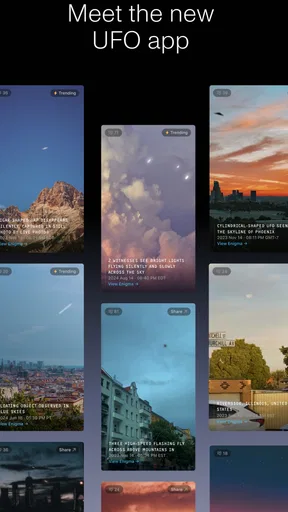
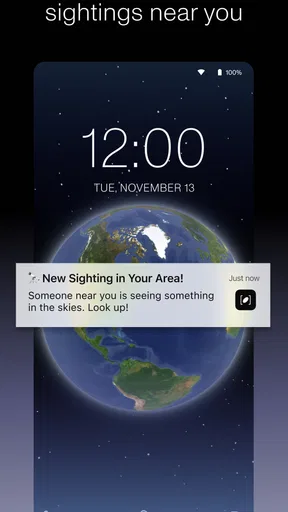
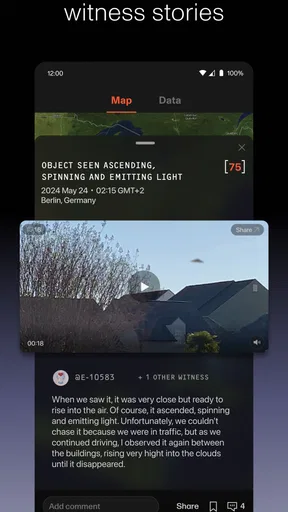
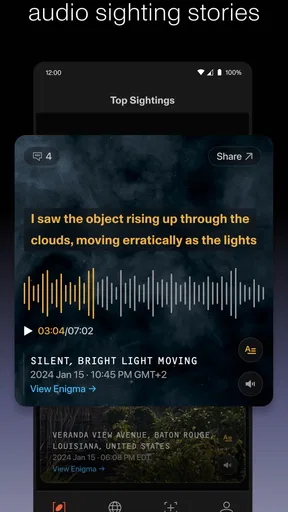


 Analysis by AppCompare
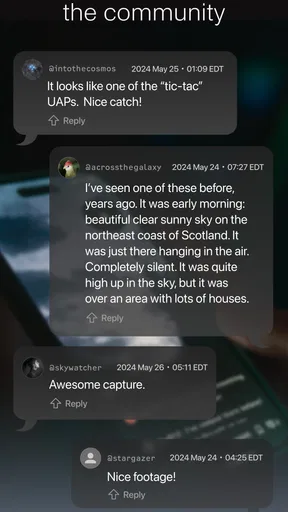
I’m drawn to sky-watching apps because they can turn a passing glance into a question worth exploring. Enigma: What’s that in the Sky is aimed at people who want to report drone and UFO sightings, so its purpose is different from a conventional astronomy guide. That distinction matters: I’d approach it as a place to document an unusual sighting and explore reports, not as a tool that can prove what an object is. For curious observers, that can still make an evening look upward feel more engaging.
A free starting point, with a specific purpose
The app is free, which makes trying it a low-commitment choice for anyone curious about unusual aerial observations. Enigma Labs, LLC is the developer, and the app sits in the news and magazines space rather than presenting itself as a standard star chart. I would not judge its value by how many astronomical facts it contains; the more relevant question is whether its reporting focus suits the way you want to explore the sky.
That focus gives it a different role from simply opening a search engine or scrolling through general news. When I see something I cannot identify, I may want to record the observation while the details are fresh and see whether other people are discussing similar sights. An app centered on sightings makes that kind of curiosity the main event. It is less compelling if all I want is a reliable answer to “Which planet is that?”
What the value depends on
Because access is free, the decision is less about whether the app is worth a purchase and more about whether I will use its subject-specific approach. The value is strongest for someone who enjoys tracking reports, comparing observations, and treating unexplained lights as questions rather than instant evidence of anything extraordinary. If that is your interest, a dedicated place for the topic can be more convenient than piecing together scattered posts across unrelated feeds.
I’d keep expectations measured. A report is an observation, not an identification, and a collection of reports cannot by itself establish what caused a sighting. Weather, aircraft, satellites, drones, distant lights, and perspective can all make the sky hard to read. I would use Enigma as a way to organize curiosity and look for context, not as a substitute for careful verification or a guarantee that an unusual object will be explained.
Discovering the Universe
The first thing you'll notice about Enigma: What’s that in the Sky is its sleek and intuitive interface. Seriously, it’s like the developers spent a good amount of time thinking about the user experience. As soon as you open the app, you’re greeted with a stunning view of the night sky. It's almost like having a planetarium in your pocket. You can move your phone around and the app will tell you what you’re looking at in real-time. So, if you’ve ever wondered whether you’re looking at a planet or a particularly bright star, wonder no more.
One of my favorite features has to be the augmented reality mode. Just point your phone at the sky, and the app overlays constellations, planets, and even satellites right on your screen. It’s like a cosmic cheat sheet. You can impress your friends by pointing out constellations like a pro, and who doesn’t want to be that person at a party?
Worth Reading Before You Choose

EA SPORTS FC Mobile 26 Is a Bigger Football Game, but It Takes Time

Flipboard Shows What News Apps Must Do Beyond the Feed

Switching to Android Auto Means Rethinking Your Driving Routine

Google Calendar Makes a Crowded Week Easier to Manage

Ludo King Makes the Most of the Minutes Between Plans

Baby Panda World Brings Quick Play to Modern Phones, but Its Game Library Feels Busy
Learning and Exploration
If you’re the kind who loves to learn, you’ll appreciate the detailed information available for each celestial object. Tap on a star or a planet, and you’re treated to a wealth of knowledge, from mythological backgrounds of constellations to technical data about planets. It’s like having an encyclopedia that’s constantly updated. And let's be honest, learning is way more fun when you’re not stuck reading dry textbooks.
The app also includes a calendar of astronomical events. So, if there's a meteor shower or a lunar eclipse on the horizon, you’ll know about it. You can even set reminders for these events. No more missing out because you forgot the date. I’ve personally set a reminder for the next meteor shower and am eagerly waiting to see it light up the night sky.
Making a useful report
For a sighting app, the most useful habit is to capture what you observed before searching for explanations. I’d note the time, place, direction of travel, duration, apparent color, and whether the light seemed steady or blinking. These details can be easy to forget after the moment passes, and writing them down first helps separate what I actually saw from what I later guessed. If the app offers a reporting flow, I’d keep the description factual and avoid labeling an object as a drone or UFO unless that is genuinely all I can say.
A realistic example: I’m walking home at dusk and notice a bright point moving across the sky. Instead of immediately posting that it is something extraordinary, I would pause somewhere safe, make a mental note of where it appeared and where it went, and check the time. I’d then use the app to see whether the sighting is worth documenting and compare it with other reports if that option is available. The useful outcome may be a better record, not a dramatic explanation.
How it fits beside other tools
Enigma is not interchangeable with a planetarium app, a flight-tracking service, or a general news feed. A sky map is usually the better first stop when the question is about stars and planets; a flight tracker is more practical when I want to check ordinary aircraft; and a local news source is better for confirmed public events. Enigma’s niche is the reporting and discussion of unusual sightings. I’d treat those tools as complements: first identify what can be identified through ordinary references, then use a sightings-focused app when uncertainty remains and I want to record the observation.
That workflow also helps avoid a common trap: interpreting a lack of an immediate match as proof of something exceptional. A map or tracker may not settle every case, and a report from another observer may describe a different object that happened to appear nearby. Comparing accounts can add perspective, but differences in location, viewing angle, and timing matter. I’d value the app most when it encourages careful observation, not when I’m looking for confirmation of a preferred theory.
User Experience and Performance
Now, let's talk a bit about performance. The app runs smoothly on both Android and iOS, which is a huge plus. No one likes an app that lags, especially when you’re trying to catch a fleeting celestial event. The developers seem to have done a fantastic job optimizing it, so you can enjoy the universe without any hiccups.
One little thing I noticed is that it does drain the battery a bit when using augmented reality mode for extended periods. But given the amount of data it processes, it's kind of expected. Just make sure your phone is charged when you head out for a stargazing session.
Practical expectations before you rely on it
For an observation that lasts only a few seconds, I would not spend that time trying to navigate menus or compose a perfect report. First watch the object, then jot down the basic details as soon as it is safe and practical. If the sighting happens while I’m driving, my priority is the road; I can record what I remember after stopping. This small change in approach is more useful than trying to turn a fleeting event into a live investigation.
It is also worth separating two kinds of curiosity. If I want to learn the names and positions of familiar celestial objects, the astronomy features described in the app can make casual stargazing more approachable. If I want to investigate an unusual light, I need to remain open to mundane explanations and use external references where appropriate. Those purposes overlap under the broad idea of looking up, but they are not the same task, and the app’s reporting identity is the clearest guide to what it is for.
The app has a 3.7 average from around 434 ratings, with 161 written reviews, and it has passed 100,000 installs. Those figures suggest a real audience, but they are not a promise that every observer will find the experience equally useful. Its Everyone 10+ age rating is also worth noting if you are choosing an app for a younger sky-watcher; I’d still encourage an adult to set expectations about speculation and evidence. The current version is 2.3.1, and it was released on February 27, 2025. It supports devices running version 7.0 or later.
Who is likely to get the most from it?
I’d recommend trying it if you already look up when something unusual catches your eye, enjoy comparing observations, or want a focused place to engage with drone and UFO reports. It may also suit a small group of friends who like turning a strange light into a calm, evidence-minded conversation: each person can describe what they saw before comparing notes, rather than letting one confident guess shape everyone else’s memory.
I’d skip it if your main need is precise astronomical identification, a dependable aircraft lookup, or authoritative answers about every light in the sky. A dedicated tool for those jobs is a better fit. I’d also avoid treating any sighting feed as a scientific verdict. The most sensible use is narrower: record an observation, see what context is available, and keep uncertainty in view.
Final Thoughts
In conclusion, Enigma: What’s that in the Sky is a fantastic tool for anyone curious about the night sky. Whether you’re a seasoned astronomer or just someone who loves to look at the stars, this app has something to offer. It’s informative, user-friendly, and just plain fun. So grab your phone, head outside, and start exploring the universe. You won’t be disappointed.
My verdict on giving it a try
My recommendation is to try it if the unusual-sighting angle genuinely interests you and you are comfortable with a tool that supports observation rather than automatically settling every mystery. Since it is free, it is easy to test whether its approach fits your habits without making a purchase decision. I would not install it expecting a definitive answer to every bright point, or choose it instead of a specialist sky map when ordinary astronomy is the goal.
For me, its best use is as a prompt to observe more carefully: notice details, record them while they are fresh, compare cautiously, and stay open to ordinary explanations. That makes Enigma a more useful companion than a source of instant certainty. If that balance sounds appealing, it is worth exploring; if you want straightforward identification or verified news, another category of app will serve you better.
Pros
- Stunning graphics enhance the immersive experience.
- Engaging and challenging puzzles keep you hooked.
- Intuitive controls make navigation seamless.
- Regular updates introduce fresh content and features.
- Multiplayer mode adds a social aspect to gameplay.
Cons
- Requires a stable internet connection to play.
- In-app purchases can become costly over time.
- Occasional lag on older devices.
- Limited offline gameplay options.
- Some puzzles may feel repetitive.
FAQs for Enigma: What’s that in the Sky
What is the main objective of Enigma: What’s that in the Sky?
Enigma: What’s that in the Sky is an adventure-puzzle game that challenges players to identify mysterious objects in the sky. The main objective is to solve intricate puzzles by deciphering clues and exploring different environments. Players can unlock levels and discover hidden secrets by using their observation and problem-solving skills.
Is Enigma: What’s that in the Sky suitable for all age groups?
Yes, Enigma: What’s that in the Sky is designed to be suitable for a wide range of age groups. The puzzles range from easy to challenging, making it accessible to both younger players and adults. It’s a family-friendly game with no inappropriate content, encouraging learning and curiosity about the world above us.
Does Enigma: What’s that in the Sky require an internet connection to play?
Enigma: What’s that in the Sky can be enjoyed both online and offline. An internet connection is required for initial download and updates, but once installed, players can explore the skies and solve puzzles without needing to be connected, making it perfect for on-the-go gaming.
Are there in-app purchases or ads in Enigma: What’s that in the Sky?
The game is free to download and play, but it offers optional in-app purchases for players who wish to enhance their experience with additional features or hints. It also contains ads, which can be removed through a one-time purchase. This allows players to enjoy the game uninterrupted if they choose.
How challenging are the puzzles in Enigma: What’s that in the Sky?
The puzzles in Enigma: What’s that in the Sky vary in complexity, providing a range of challenges suitable for different skill levels. Beginners will find introductory puzzles that gradually increase in difficulty, while seasoned players can enjoy more intricate challenges that require deeper thinking and exploration to solve.


